Application of the Spectral Galarkin Method for Solving Integral Heat Transfer Equations Based on Chebeshev and Hermit Polynomial Bases
DOI:
https://doi.org/10.70844/ijas.2026.3.51Keywords:
- Spectral Galerkin method,
- Integral equations,
- Heat conduction,
- Chebyshev polynomials,
- Hermite polynomials,
- Orthogonal bases,
- Numerical accuracy,
- Thermal diffusion
Abstract
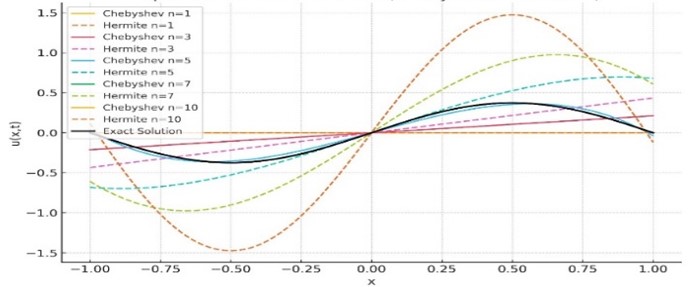
This study proposes a robust and high-fidelity numerical framework for solving the integral form of the One-Dimensional (1D) unsteady Heat Conduction (HC) equation. The framework is built upon the spectral Galerkin method utilizing Chebyshev and Hermite polynomials as orthogonal basis functions for spatial discretization. By reformulating the classical parabolic heat equation into an equivalent integral representation using Green’s function and the Laplace transform the problem gains enhanced smoothness and numerical stability-particularly in the presence of sharp gradients or boundary layers. The spectral Galerkin method renowned for its exponential convergence when applied to smooth problems was implemented using both polynomial bases Comparative numerical experiments indicate that Chebyshev polynomials exhibit superior accuracy and faster convergence compared to Hermite polynomials within bounded domains in contrast, Hermite polynomials despite their theoretical strength on unbounded intervals displayed slower convergence and higher approximation errors when constrained to finite domains. Error analyses conducted for multiple polynomial degrees (n=2,4,6,8,10) confirmed the spectral nature of the convergence with Chebyshev-based solutions consistently outperforming their Hermite counterparts. As a result, the study concludes that Chebyshev polynomials are the more appropriate choice for solving bounded-domain heat conduction problems using the integral Galerkin spectral method The proposed methodology not only ensures stability and high-order accuracy for classical thermal problems but also offers a promising foundation for future extensions to nonlinear time-dependent and multidimensional heat transfer systems.
Downloads
References
1. Boyd JP (2001) Chebyshev and Fourier spectral methods. 2nd edn. Dover Publications.
2. Atkinson KE (1997) The numerical solution of integral equations of the second kind. Cambridge university press.
3. Shen J, Tang T, Wang LL (2011) Spectral methods: Algorithms, analysis and applications. Springer.
4. Özisik MN (1993) Heat conduction. 2nd edn. Wiley.
5. Evans LC (2010) Partial differential equations. 2nd edn. American Mathematical Society.
6. Polyanin AD, Manzhirov AV (2008) Handbook of integral equations. Chapman & Hall/CRC.
7. Churchill RV, Brown JW (2006) Fourier series and boundary value problems. 7th edn. McGraw-Hill.
8. Canuto C, Hussaini MY, Quarteroni A, Zang TA (2006) Spectral methods: Fundamentals in single domains. Springer.
9. Abramowitz M, Stegun IA (1965) Handbook of mathematical functions. U.S. National Bureau of Standards.
10. Canuto C, Hussaini MY, Quarteroni A, Zang TA (1988) Spectral methods in fluid dynamics. Springer.
11. Trefethen LN (2000) Spectral methods in MATLAB. SIAM.
12. Hairer E, Nørsett SP, Wanner G (1993) Solving ordinary differential equations I: Nonstiff problems. 2nd edn. Springer.