Artificial Intelligence-Driven User-Centered Design and Employee Productivity in AI-Integrated Call Centers: A Systematic Literature Review and Integrative Framework
DOI:
https://doi.org/10.70844/ijas.2026.3.58Keywords:
- Artificial intelligence,
- User-centered design,
- Technostress,
- Employee productivity,
- BPO call centers,
- Kenya,
- Adaptive interfaces,
- Job demands-resources model
Abstract
Introduction: Artificial Intelligence (AI) is rapidly transforming Kenya's Business Process Outsourcing (BPO) sector, exposing call-center agents to technostress from complex systems, algorithmic monitoring and constant connectivity. User-Centered Design (UCD) has been suggested as a means to convert AI from a source of strain to a resource that facilitates work, but no peer-reviewed study has investigated this proposition in Kenya’s AI-integrated call centers.
Objective: To synthesize evidence on (i) theories explaining technostress, user centered design and AI adoption; (ii) effect of intuitive interface design on agent productivity; (iii) challenges to AI-user centered design integration in the BPO sector in Kenya; and (iv) directions for future research.
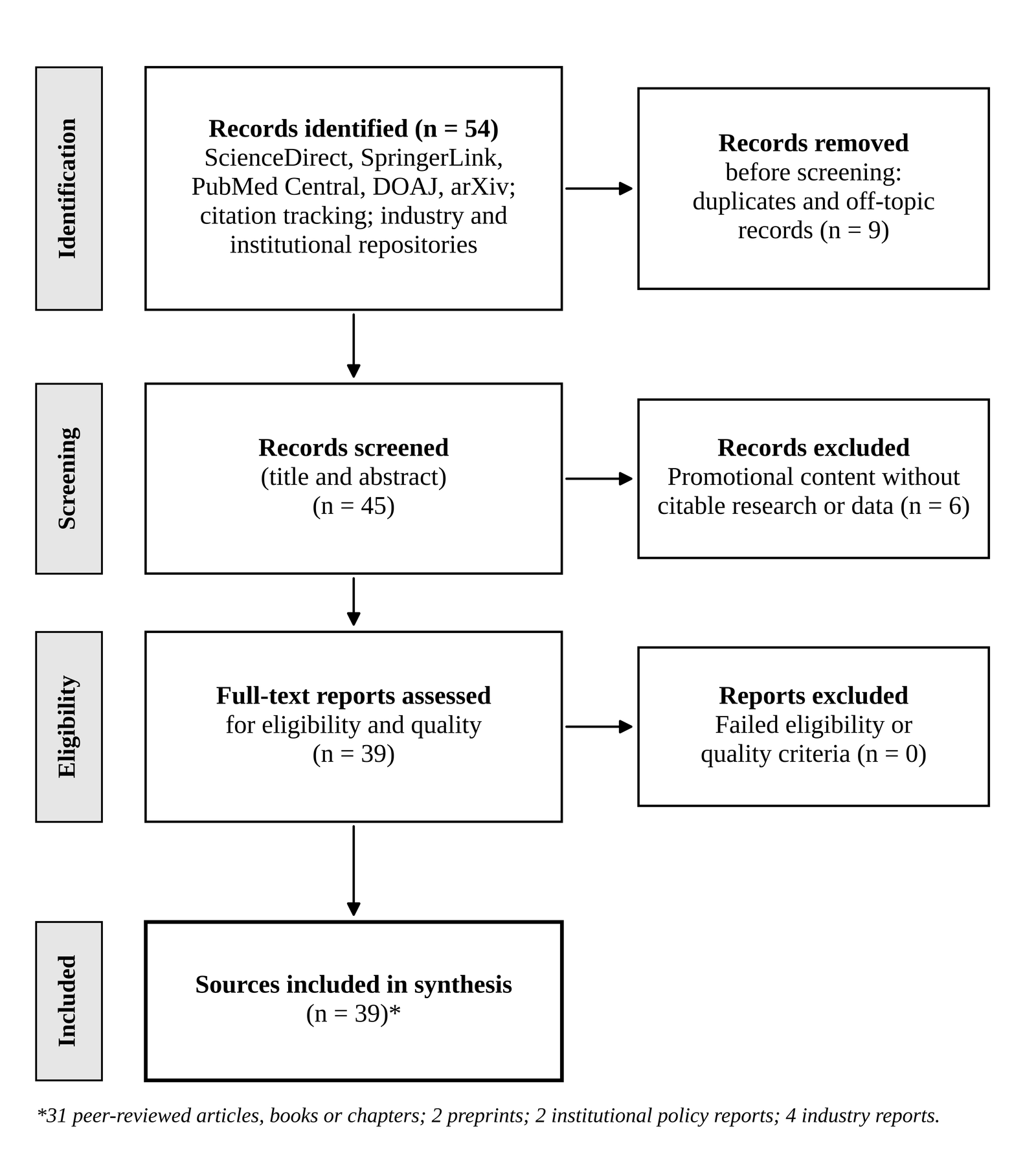
Methods: Searches were performed across ScienceDirect, SpringerLink, PubMed Central, DOAJ and arXiv, according to PRISMA 2020 guidelines and complemented by citation tracking and industry repositories. The final search was completed on 28 September 2026. Of the 54 identified records, 39 sources were eligible and met the quality criteria. Each source was given an evidential weight and synthesized through provisional coding, using the Job Demands-Resources (JD-R) model as the integrating lens.
Results: Adaptive interfaces and formal and structured user involvement received the most empirical support. These reduce cognitive load and increase system use. The obstacles to integration were mostly organizational rather than technical. Only four of the 39 sources referenced Kenya and none were peer-reviewed. The synthesis resulted in an integrative UCD-JD-R framework with seven testable propositions and a prioritized research agenda.
Conclusions: Rapid AI adoption, well-evidenced but geographically distant UCD research and the absence of a Kenya-specific evidence base together form an urgent gap. There is a need for context-specific, longitudinal and organizationally embedded research and the proposed framework provides a foundation for testing how artificial intelligence can be deployed to protect agent well-being and productivity.
Downloads
References
1. Soyangco PR, Riva MRD, Narsico PG, Niere MIE, Narsico LO (2024) Optimizing call center productivity through key work environment factors. International Journal of Multidisciplinary: Applied Business and Education Research 5(11): 4759-4787.
2. White K (2024) The rise of call centers and business process outsourcing in Africa. Site Selection Group.
3. Bakker AB, Demerouti E (2007) The job demands-resources model: state of the art. Journal of Managerial Psychology 22(3): 309-328.
4. Pansini M, Buonomo I, De Vincenzi C, Ferrara B, Benevene P (2023) Positioning technostress in the JD-R model perspective: A systematic literature review. Healthcare (Basel) 11(3): 446.
5. Tarafdar M, Tu Q, Ragu-Nathan BS, Ragu-Nathan TS (2007) The impact of technostress on role stress and productivity. Journal of management information systems 24(1): 301-328.
6. Ragu-Nathan TS, Tarafdar M, Ragu-Nathan BS, Tu Q (2008) The consequences of technostress for end users in organizations: conceptual development and empirical validation. Information Systems Research 19(4): 417-433.
7. Nastjuk I, Trang S, Grummeck-Braamt JV, Adam MTP, Tarafdar M (2024) Integrating and synthesising technostress research: a meta-analysis on technostress creators, outcomes and IS usage contexts. European Journal of Information Systems 33(3): 361-382.
8. Tarafdar M, Cooper CL, Stich JF (2019) The technostress trifecta – techno eustress, techno distress and design: theoretical directions and an agenda for research. Information systems journal 29(1): 6-42.
9. Poisat P, Cullen M, Calitz AP (2024) Human resource managers' perceptions on the impact of AI on the South African workforce. SA Journal of Human Resource Management 22: a2593.
10. Kellogg KC, Valentine MA, Christin A (2020) Algorithms at work: the new contested terrain of control. Academy of Management Annals 14(1): 366-410.
11. International Labour Organization (2024) Algorithmic management practices in regular workplaces. Geneva: ILO.
12. Yam KC, Tang PM, Jackson JC, Su R, Gray K (2023) The rise of robots increases job insecurity and maladaptive workplace behaviors: multimethod evidence. Journal of Applied Psychology 108(5): 850-870.
13. Giwa F, Ngepah N (2024) The relationship between artificial intelligence and low-skilled employment in South Africa. Heliyon 10(23): e40640.
14. Callin (2025) Outsourced call centre Kenya in 2025.
15. Outsource Accelerator (2026) Top 20 BPO companies in Kenya.
16. HelloDuty (2024) A comprehensive guide to call centers in Kenya and Africa.
17. Rohwer E, Flöther JC, Harth V, Mache S (2022) Overcoming the "dark side" of technology – a scoping review on preventing and coping with work-related technostress. International Journal of Environmental Research and Public Health 19(6): 3625.
18. Mdhluli NI (2026) Artificial intelligence and employee assistance programmes in South Africa: a systematic review of ethical, cultural and digital transformation requirements for workforce well-being. SA Journal of Industrial Psychology 52: a2354.
19. Bahamondes-Rosado ME, Cerdá-Suárez LM, Dodero Ortiz de Zevallos GF, Espinosa-Cristia JF (2023) Technostress at work during the COVID-19 lockdown phase (2020–2021): a systematic review of the literature. Frontiers in Psychology 14: 1173425.
20. Borle P, Reichel K, Voelter-Mahlknecht S (2021) Is there a sampling bias in research on work-related technostress? A systematic review of occupational exposure to technostress and the role of socioeconomic position. International Journal of Environmental Research and Public Health 18(4): 2071.
21. La Torre G, Esposito A, Sciarra I, Chiappetta M (2019) Definition, symptoms and risk of techno-stress: A systematic review. International Archives of Occupational and Environmental Health 92(1): 13-35.
22. Norman DA, Draper SW, editors (1986) User centered system design: New perspectives on human-computer interaction. Hillsdale, NJ: Lawrence Erlbaum Associates.
23. Brod C (1984) Technostress: The human cost of the computer revolution. Reading, MA: Addison-Wesley.
24. Weil MM, Rosen LD (1997) TechnoStress: Coping with Technology @Work @Home @Play. New York: John Wiley & Sons.
25. Page MJ, McKenzie JE, Bossuyt PM, Boutron I, Hoffmann TC, et al. (2021) The PRISMA 2020 statement: an updated guideline for reporting systematic reviews. BMJ 372: n71.
26. Goodhue DL, Thompson RL (1995) Task-technology fit and individual performance. MIS Q 19(2): 213-236.
27. Edwards JR (2008) Person-environment fit in organizations: An assessment of theoretical progress. Academy of Management Annals 2(1): 167-230.
28. Lazarus RS, Folkman S (1984) Stress, appraisal and coping. New York: Springer.
29. Venkatesh V, Morris MG, Davis GB, Davis FD (2003) User acceptance of information technology: Toward a unified view. MIS Q 27(3): 425-478.
30. Scholze A, Hecker A (2024) The job demands-resources model as a theoretical lens for the bright and dark side of digitization. Computers in human behavior 155: 108177.
31. Chang PC, Zhang W, Cai Q, Guo H (2024) Does AI-driven technostress promote or hinder employees' artificial intelligence adoption intention? A moderated mediation model of affective reactions and technical self-efficacy. Psychology Research and Behavior Management 17: 413-427.
32. Wang YY, Wang YS (2022) Development and validation of an artificial intelligence anxiety scale: an initial application in predicting motivated learning behavior. Interactive Learning Environments 30(4): 619-634.
33. Saleem F, Malik MI, Qureshi SS, Farid MF, Qamar S (2021) Technostress and employee performance nexus during COVID-19: Training and creative self-efficacy as moderators. Frontiers in Psychology 12: 595119.
34. Fischer T, Riedl R (2020) Technostress mitigation: an experimental study of social support during a computer freeze. Journal of Business Economics 90: 1199-1249.
35. Malik MJN, Ali M, Malik A, Malik S (2025) Twin threats in digital workplace: technostress and work intensification in a dual-path moderated mediation model of employee health. International Journal of Environmental Research and Public Health 22(12): 1856.
36. Montazer F, Ahmadi M (2024) Designing adaptive interfaces in the metaverse: reducing cognitive load for enhanced user experience. International Journal of Advanced Human Computer Interaction 2(2): 44-54.
37. Carrera-Rivera A, Larrinaga F (2023) Exploring the transformation of user interactions to adaptive human-machine interfaces. InProceedings of the XXIII International Conference on Human Computer Interaction 1-7.
38. Hamdani R, Chihi I (2025) Adaptive human-computer interaction for industry 5.0: A novel concept, with comprehensive review and empirical validation. Computer in Industry 168: 104268.
39. Wang Y (2025) Fatigue-aware adaptive interfaces for wearable devices using deep learning. arXiv preprint arXiv: 2506.13203.
40. Bano M, Zowghi D (2015) A systematic review on the relationship between user involvement and system success. Information and Software Technology 58: 148-169.
41. Olson MH, Ives B (1981) User involvement in system design: An empirical test of alternative approaches. Information & Management 4(4): 183-196.
42. Baroudi JJ, Olson MH, Ives B (1986) An empirical study of the impact of user involvement on system usage and information satisfaction. Communications of the ACM 29(3): 232-238.
43. McKeen JD, Guimaraes T, Wetherbe JC (1994) The relationship between user participation and user satisfaction: An investigation of four contingency factors. MIS Q 18(4): 427-451.
44. Gorichanaz T (2025) Identifying the barriers to human-centered design in the workplace: Perspectives from UX professionals. Proceedings of the ACM on Human-Computer Interaction 9(2): 1-25.
45. Nair M, Svedberg P, Larsson I, Nygren JM (2024) A comprehensive overview of barriers and strategies for AI implementation in healthcare: Mixed-method design. PLoS One 19(8): e0305949.
46. Winby S, Xu W (2026) Human-centered AI maturity model (HCAI-MM): An organizational design perspective. In: Xu W, editor. Handbook of Human-Centered Artificial Intelligence. Springer.
47. European Parliamentary Research Service (2025) Digitalisation, artificial intelligence and algorithmic management in the workplace: Shaping the future of work. Brussels: European Parliament.
48. Hlatshwayo MC, Oyetade K, Zuva T (2026) Ethical AI adoption in South African SMEs using a contextual framework. In: Handbook of Emerging Technology Adoption. Singapore: Springer.
49. Harunavamwe M, Ward C (2022) The influence of technostress, work–family conflict and perceived organisational support on workplace flourishing amidst COVID-19. Frontiers in Psychology 13: 921211.
50. Miles MB, Huberman AM, Saldaña J (2014) Qualitative data analysis: A methods sourcebook. 3rd edn. Thousand Oaks, CA: SAGE.
51. Republic of Kenya (2019) The data protection act, no. 24 of 2019. Nairobi: Government Printer.