Machine Learning for Detecting Colony Collapse Disorder and Colony Losses in Honeybees (Apis mellifera): A PRISMA 2020 Systematic Review
DOI:
https://doi.org/10.70844/ijas.2026.3.59Keywords:
- Colony collapse disorder,
- Colony losses,
- Machine learning,
- Deep learning,
- Precision beekeeping,
- Bioacoustic,
- Varroa destructor,
- Systematic review
Abstract
Introduction: Globally, pollination services and beekeeping livelihoods are at risk due to Colony Collapse Disorder (CCD) and increased colony losses. Although Machine Learning (ML) applied to hive sensor, image and survey data promises early warning, the evidence has not been synthesised with a focus on collapse and loss.
Objective: To map and appraise studies that used ML to detect or predict CCD, colony loss, or the colony-health states that precede loss in honeybees (Apis mellifera) and to examine their data, models, validation processes and deployment levels.
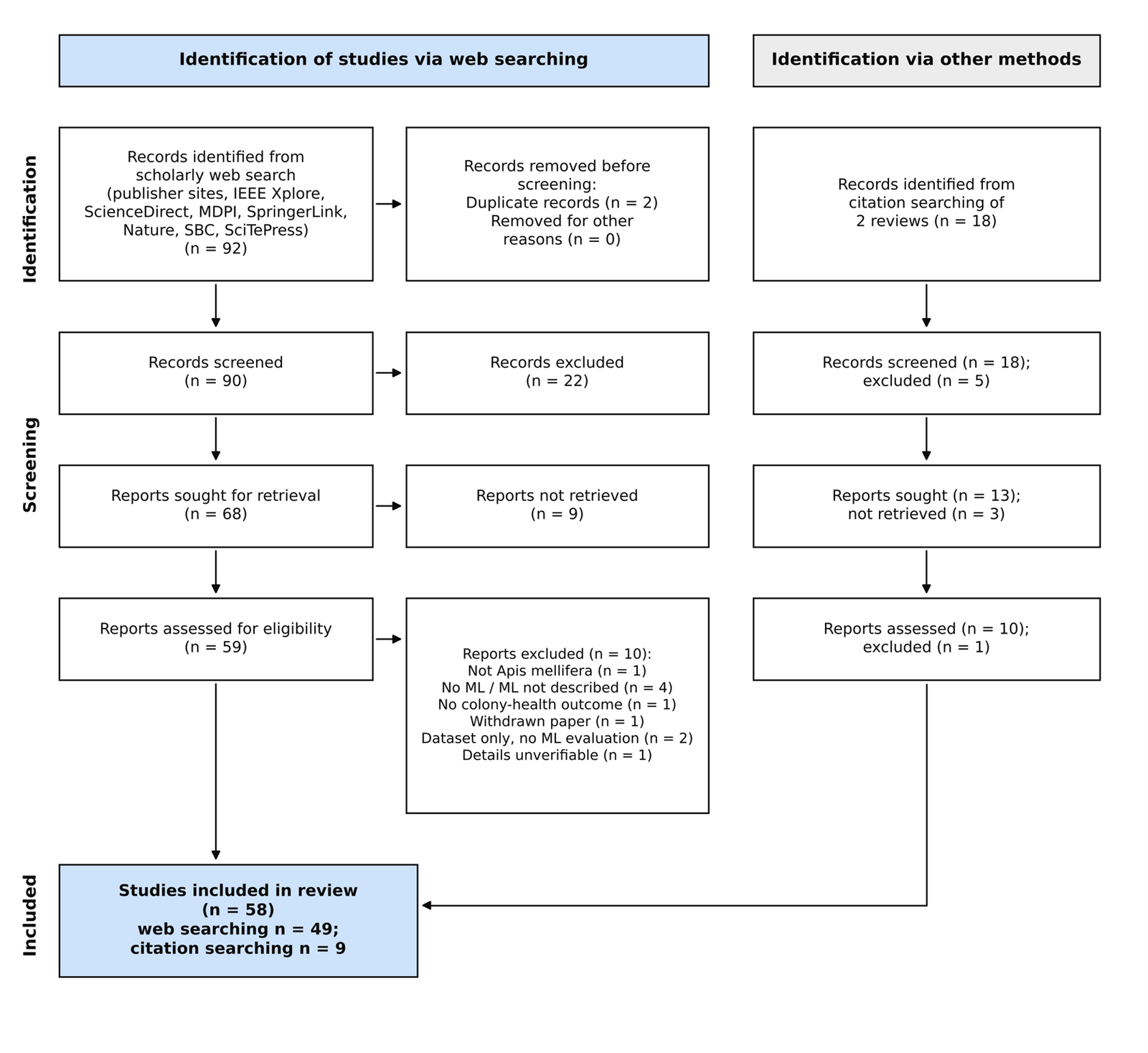
Methods: Following PRISMA 2020, peer-reviewed studies published between 2015 and 2025 were identified through structured scholarly web searching and citation searching of two recent reviews. After 108 records were screened and 69 full texts assessed, 58 studies were included. Task, modality, dataset, model, validation, performance and deployment data were extracted and methodological quality was appraised with an eight-item checklist tailored to ML research.
Results: Colony collapse was explicitly modelled in only two studies. The remainder addressed precursors: parasites and diseases (16 studies, mainly Varroa destructor), queen status (13), multi-condition anomalies (12), swarming (8), colony loss or winter mortality (4) and colony strength (3). Acoustic monitoring predominated (27 studies) and deep learning was the most common model family (20 studies). Reported accuracies frequently approached 95%, but only ten studies tested models on independent hives, where performance declined markedly; loss-prediction models reached roughly 65–75% accuracy. Eighteen studies were of high, 26 of moderate and 14 of low quality.
Conclusions: ML consistently identifies several proximate causes of colony failure, but evidence for forecasting collapse itself is limited. Progress requires longitudinal, multi-apiary datasets with confirmed loss outcomes, multimodal fusion, hive-independent validation and open data and code.
Downloads
References
1. Klein AM, Vaissière BE, Cane JH, Steffan-Dewenter I, Cunningham SA, et al. (2007) Importance of pollinators in changing landscapes for world crops. Proceedings of the Royal Society B: Biological Sciences 274(1608): 303-313.
2. Potts SG, Biesmeijer JC, Kremen C, Neumann P, Schweiger O, et al. (2010) Global pollinator declines: Trends, impacts and drivers. Trends in Ecology & Evolution 25(6): 345-353.
3. Cox-Foster DL, Conlan S, Holmes EC, Palacios G, Evans JD, et al. (2007) A metagenomic survey of microbes in honey bee colony collapse disorder. Science 318(5848): 283-287.
4. vanEngelsdorp D, Evans JD, Saegerman C, Mullin C, Haubruge E, et al. (2009) Colony collapse disorder: A descriptive study. PLoS ONE 4(8): e6481.
5. Neumann P, Carreck NL (2010) Honey bee colony losses. Journal of Apicultural Research 49(1): 1-6.
6. Goulson D, Nicholls E, Botías C, Rotheray EL (2015) Bee declines driven by combined stress from parasites, pesticides and lack of flowers. Science 347(6229): 1255957.
7. Steinhauer N, Kulhanek K, Antúnez K, Human H, Chantawannakul P, et al. (2018) Drivers of colony losses. Current Opinion in Insect Science 26: 142-148.
8. Gray A, Adjlane N, Arab A, Ballis A, Brusbardis V, et al. (2020) Honey bee colony winter loss rates for 35 countries participating in the COLOSS survey for winter 2018–2019 and the effects of a new queen on the risk of colony winter loss. Journal of Apicultural Research 59(5): 744-751.
9. Meikle WG, Holst N (2015) Application of continuous monitoring of honeybee colonies. Apidologie 46(1): 10-22.
10. Zacepins A, Brusbardis V, Meitalovs J, Stalidzans E (2015) Challenges in the development of precision beekeeping. Biosystems Engineering 130: 60-71.
11. Hadjur H, Ammar D, Lefèvre L (2022) Toward an intelligent and efficient beehive: A survey of precision beekeeping systems and services. Computers and Electronics in Agriculture 192: 106604.
12. Bilik S, Zemcik T, Kratochvila L, Ricanek D, Richter M, et al. (2024) Machine learning and computer vision techniques in continuous beehive monitoring applications: A survey. Computers and Electronics in Agriculture 217: 108560.
13. Šabić J, Perković T, Šolić P, Šerić L (2025) Buzzing with intelligence: A systematic review of smart beehive technologies. Sensors 25(17): 5359.
14. Sucipto W, Zhou J, Kwon RSM, Chen F (2025) A survey of TinyML applications in beekeeping for hive monitoring and management. arXiv:2509.08822.
15. Abadade Y, Temouden A, Bamoumen H, Benamar N, Chtouki Y, et al. (2023) A comprehensive survey on TinyML. IEEE 11: 96892-96922.
16. Heydari S, Mahmoud QH (2025) Tiny machine learning and on-device inference: A survey of applications, challenges and future directions. Sensors 25(10): 3191.
17. Somvanshi S, Islam MM, Chhetri G, Chakraborty R, Mimi MS, et al. (2025) From tiny machine learning to tiny deep learning: A survey. arXiv:2506.18927.
18. Han H, Trimi S, Lee SM (2026) Tiny machine learning (TinyML): Research trends and future application opportunities. Array 29: 100674.
19. Page MJ, McKenzie JE, Bossuyt PM, Boutron I, Hoffmann TC, et al. (2021) The PRISMA 2020 statement: An updated guideline for reporting systematic reviews. BMJ 372: n71.
20. Rosenkranz P, Aumeier P, Ziegelmann B (2010) Biology and control of Varroa destructor. Journal of Invertebrate Pathology 103: S96-S119.
21. Wolff RF, Moons KGM, Riley RD, Whiting PF, Westwood M, et al. (2019) PROBAST: A tool to assess the risk of bias and applicability of prediction model studies. Annals of Internal Medicine 170(1): 51-58.
22. Mongan J, Moy L, Kahn CE Jr (2020) Checklist for Artificial Intelligence in Medical Imaging (CLAIM): A guide for authors and reviewers. Radiology: Artificial Intelligence 2(2): e200029.
23. Kontogiannis S (2024) Beehive smart detector device for the detection of critical conditions that utilize edge device computations and deep learning inferences. Sensors 24(16): 5444.
24. Zhukov OO, Horbenko VI (2025) Using time series and LSTM neural networks for identification of hive states. Information Technologies and Mathematical Modelling (ITMM) 2025.
25. Calovi M, Grozinger CM, Miller DA, Goslee SC (2021) Summer weather conditions influence winter survival of honey bees (Apis mellifera) in the northeastern United States. Scientific Reports 11.
26. Insolia L, Molinari R, Rogers SR, Williams GR, Chiaromonte F, et al. (2022) Honey bee colony loss linked to parasites, pesticides and extreme weather across the United States. Scientific Reports 12.
27. García-Vicente EJ, Benito-Murcia M, Martín Domínguez M, Pérez Pérez A, González Sánchez M, et al. (2024) Main causes of producing honey bee colony losses in southwestern Spain: A novel machine learning-based approach. Apidologie 55(5): 67.
28. Zhu Y, Abdollahi M, Maucourt S, Coallier N, Guimarães HR, et al. (2024) MSPB: A longitudinal multi-sensor dataset with phenotypic trait measurements from honey bees. Scientific Data 11: 860.
29. Braga AR, Silva DA, Nobre JS, Freitas BM, Gomes DG (2019) Defining and predicting honeybee colony health levels through clustering and classification (Definindo e predizendo níveis de saúde de colônias de abelhas via clusterização e classificação). In: SBBD 2019: 241-246.
30. Kaplan Berkaya S, Sora Gunal E, Gunal S (2021) Deep learning-based classification models for beehive monitoring. Ecological Informatics 64: 101353.
31. Kim J, Oh J, Heo TY (2021) Acoustic scene classification and visualization of beehive sounds using machine learning algorithms and Grad-CAM. Mathematical Problems in Engineering 2021: 5594498.
32. Rodrigues IL, de Melo DB, Freitas BM, Gomes DG (2021) Detecção de anomalias em padrões acústicos, de temperatura e umidade sazonais para abelhas melíferas (Apis mellifera L.). In: Anais do XII Workshop de Computação Aplicada à Gestão do Meio Ambiente e Recursos Naturais (WCAMA 2021) 69-78.
33. Cejrowski T, Szymański J (2022) Detection of anomalies in bee colony using transitioning state and contrastive autoencoders. Computers and Electronics in Agriculture 200: 107207.
34. Senger D, Kluss T, Förster A (2023) Towards a warning system for beekeepers: Detecting anomalous changes in sensor data from honey bee colonies. In: EnviroInfo 2023 15-24.
35. Torky M, Nasr AA, Hassanien AE (2023) Recognizing beehives' health abnormalities based on MobileNet deep learning model. International Journal of Computational Intelligence Systems 16: 135.
36. Chen SH, Wang JC, Lin HJ, Lee MH, Liu AC, et al. (2024) A machine learning-based multiclass classification model for bee colony anomaly identification using an IoT-based audio monitoring system with an edge computing framework. Expert Systems with Applications 255: 124898.
37. Faramarzi P, Alimardani R, Rabbani H, Mousazadeh H (2024) Acoustic analysis of beehives for precision beekeeping based on the Internet of Things: A case study on improving hive health and productivity. Iranian Journal of Biosystem Engineering 55(3): 49-71.
38. Hammami H, Abdulaziz N (2024) BeeBetter: A multi-modal beehive system for honeybee health monitoring and hazard detection. In: ICSPIS 2024, IEEE.
39. Zhukov O, Horbenko V (2024) An adaptive approach to the bee hive state identification using neural networks and audio analysis. System Technologies 4(153).
40. Mustafa S, Mohaghegh M, Ardekani I, Sarrafzadeh A (2025) Leveraging machine learning approaches to decode hive sounds for stress prediction. IEEE Access 13: 147953-147971.
41. Schurischuster S, Remeseiro B, Radeva P, Kampel M (2018) A preliminary study of image analysis for parasite detection on honey bees. In: ICIAR 2018, LNCS 10882.
42. Bjerge K, Frigaard CE, Mikkelsen PH, Nielsen TH, Misbih M, et al. (2019) A computer vision system to monitor the infestation level of Varroa destructor in a honeybee colony. Computers and Electronics in Agriculture 164: 104898.
43. Szczurek A, Maciejewska M, Bąk B, Wilk J, Wilde J, et al. (2020) Classification of honeybee infestation by Varroa destructor using gas sensor array. In: SENSORNETS 2020 61-68.
44. Szczurek A, Maciejewska M, Bąk B, Wilk J, Wilde J, et al. (2020) Gas sensor array and classifiers as a means of varroosis detection. Sensors 20(1): 117.
45. Bilik S, Kratochvila L, Ligocki A, Bostik O, Zemcik T, et al. (2021) Visual diagnosis of the Varroa destructor parasitic mite in honeybees using object detector techniques. Sensors 21(8): 2764.
46. Mrozek D, Górny R, Wachowicz A, Małysiak-Mrozek B (2021) Edge-based detection of varroosis in beehives with IoT devices with embedded and TPU-accelerated machine learning. Applied Sciences 11(22): 11078.
47. Picek L, Novozamsky A, Frydrychová RC, Zitová B, Mach P (2022) Monitoring of Varroa infestation rate in beehives: A simple AI approach. In: IEEE ICIP 2022 3341-3345.
48. Voudiotis G, Moraiti A, Kontogiannis S (2022) Deep learning beehive monitoring system for early detection of the Varroa mite. Signals 3(3): 506-523.
49. Divasón J, Martinez-de-Pison FJ, Romero A, Santolaria P, Yániz JL (2023) Varroa mite detection using deep learning techniques. In: Hybrid Artificial Intelligent Systems (HAIS 2023), LNCS.
50. Divasón J, Romero A, Martinez-de-Pison FJ, Casalongue M, Silvestre MA, et al. (2024) Analysis of Varroa mite colony infestation level using new open software based on deep learning techniques. Sensors 24(12): 3828.
51. Duma ZS, Zemcik T, Bilik S, Sihvonen T, Honec P, et al. (2024) Varroa destructor detection on honey bees using hyperspectral imagery. Computers and Electronics in Agriculture 224: 109219.
52. Ghezal A, Peña CJL, König A (2024) Varroa mite counting based on hyperspectral imaging. Sensors 24(14): 4437.
53. Sharma A, Varastehpour S, Ardekani I, Sharifzadeh H (2024) Bee disease Varroa prediction: Utilizing convolutional neural networks with augmentation for robust detection and identification of honeybee infection. In: ICIESTR 2024, IEEE.
54. Ghezal A, König A (2025) A comparative study of hybrid machine-learning vs. deep-learning approaches for Varroa mite detection and counting. Sensors 25(16): 5075.
55. Scutaru D, Bergonzoli S, Costa C, Violino S, Costa C, et al. (2025) An AI-based digital scanner for Varroa destructor detection in beekeeping. Insects 16(1): 75.
56. Yániz J, Casalongue M, Martinez-de-Pison FJ, Silvestre MA, Beeguards Consortium, et al. (2025) An AI-based open-source software for Varroa mite fall analysis in honeybee colonies. Agriculture 15(9): 969.
57. Robles-Guerrero A, Saucedo-Anaya T, González-Ramírez E, Galván-Tejada CE (2017) Frequency analysis of honey bee buzz for automatic recognition of health status: a preliminary study. Research in Computing Science 142: 89-98.
58. Nolasco I, Terenzi A, Cecchi S, Orcioni S, Bear HL, et al. (2019) Audio-based identification of beehive states. In: IEEE ICASSP 2019.
59. Ruvinga S, Hunter GJA, Duran O, Nebel JC (2021) Use of LSTM neural networks to identify 'queenlessness' in honeybee hives from audio signals. In: 17th International Conference on Intelligent Environments (IE 2021).
60. Rodrigues IL, de Melo DB, da Silva DA, Rybarczyk Y, Gomes DG (2022) Padrões bioacústicos como identificadores precisos da presença de rainha em colmeias de abelhas melíferas. In: WCAMA 2022 11-20.
61. Terenzi A, Ortolani N, Nolasco I, Benetos E, Cecchi S (2022) Comparison of feature extraction methods for sound-based classification of honey bee activity. IEEE/ACM Transactions on Audio, Speech and Language Processing 30: 112-122.
62. Barbisan L, Turvani G, Riente F (2023) Audio-based identification of queen bee presence inside beehives. In: IEEE CAFE 2023 70-74.
63. Ruvinga S, Hunter G, Duran O, Nebel JC (2023) Identifying queenlessness in honeybee hives from audio signals using machine learning. Electronics 12(7): 1627.
64. Bricout A, Leleux P, Acco P, Escriba C, Fourniols JY, et al. (2024) Bee Together: Joining bee audio datasets for hive extrapolation in AI-based monitoring. Sensors 24(18): 6067.
65. De Simone A, Barbisan L, Turvani G, Riente F (2024) Advancing beekeeping: IoT and TinyML for queen bee monitoring using audio signals. IEEE Transactions on Instrumentation and Measurement 73: 1-9.
66. Huang W, Yang W, Luo Z, Qi J, Zhang T, et al. (2024) Sound-based bee colony state analysis using compact MFCC patterns. In: IEEE ISPA 2024, 2164-2169.
67. Nguyen Ba N, Pham Thi Kim P, Tran Thanh H, Le An T, Doan Van T, et al. (2024) Monitoring the absence of queen bee in the hive using deep learning and Hilbert Huang Transform. ASEAN Engineering Journal 14(1): 113-120.
68. Carvalho CM Jr, Rodrigues IL, Gomes DG (2025) Unsupervised acoustic detection of queenless hives in honeybees (Apis mellifera ligustica). In: Brazilian e-Science Workshop (BreSci 2025) 49-56.
69. Sad C, Kampelopoulos D, Sofianidis I, Kanelis D, Nikolaidis S, et al. (2025) Deep edge IoT for acoustic detection of queenless beehives. Electronics 14(15): 2959.
70. Davidson P, Steininger M, Lautenschlager F, Kobs K, Krause A, et al. (2020) Anomaly detection in beehives using deep recurrent autoencoders. In: SENSORNETS 2020, 142-149.
71. Ramsey MT, Bencsik M, Newton MI, Reyes M, Pioz M, et al. (2020) The prediction of swarming in honeybee colonies using vibrational spectra. Scientific Reports 10: 9798.
72. Zgank A (2021) IoT-based bee swarm activity acoustic classification using deep neural networks. Sensors 21(3): 676.
73. Kiromitis DI, Bellos CV, Stefanou KA, Stergios GS andrikos I, et al. (2022) Performance evaluation of classification algorithms to detect bee swarming events using sound. Signals 3(4): 807-822.
74. Ruvinga S, Hunter G, Nebel JC, Duran O (2022) Prediction of honeybee swarms using audio signals and convolutional neural networks. In: Workshops at IE2022, IOS Press (AISE), 146-154.
75. Várkonyi DT, Seixas Junior JL, Horváth T (2023) Dynamic noise filtering for multi-class classification of beehive audio data. Expert Systems with Applications 213: 118850.
76. Iqbal K, Alabdullah B, Al Mudawi N, Algarni A, Jalal A, et al. (2024) Empirical analysis of honeybees acoustics as biosensors signals for swarm prediction in beehives. IEEE Access 12: 148405-148421.
77. Libal U, Biernacki P (2024) Drone flight detection at an entrance to a beehive based on audio signals. Archives of Acoustics 49(3): 459-468.
78. Abdollahi M, Henry E, Giovenazzo P, Falk TH (2023) The importance of context awareness in acoustics-based automated beehive monitoring. Applied Sciences 13(1): 195.
79. Luz JS, de Oliveira MC, Pereira FM, de Araújo FHD, Magalhães DMV (2024) Cepstral and deep features for Apis mellifera hive strength classification. Journal of Internet Services and Applications 15(1): 548-560.
80. Abdollahi M, Zhu Y, Guimarães HR, Coallier N, Maucourt S, et al. (2025) UrBAN: Urban beehive acoustics and phenotyping dataset. Scientific Data 12.
81. Kapoor S, Narayanan A (2023) Leakage and the reproducibility crisis in machine-learning-based science. Patterns 4(9): 100804.