Responsible AI in Academic Research: A Scoping Review and Evidence-Gap Map of Ethical Principles, Challenges and Governance
DOI:
https://doi.org/10.70844/ijas.2026.3.57Keywords:
- Artificial intelligence,
- Research ethics,
- Research integrity,
- Generative AI,
- Large language models,
- Scoping review,
- Evidence-gap map,
- Research governance,
- Higher education
Abstract
Introduction: Artificial Intelligence (AI) is now used at every stage of the academic research life cycle, yet the rules governing its use remain fragmented and the evidence base is dispersed across disciplines and document types.
Objective: To map the nature, extent and distribution of evidence on the ethics of using AI to conduct, report, review and govern academic research and to identify where evidence and governance are lacking.
Methods: A scoping review was conducted following JBI guidance and reported according to the PRISMA extension for scoping reviews (PRISMA-ScR). Thirty-four structured search strings and citation chasing were used to identify documents published between 2015 and 2025. Each principal finding was linked to the type and amount of supporting evidence using a transparent confidence rule and included items were cross-tabulated by theme and research-lifecycle stage in an evidence-gap map.
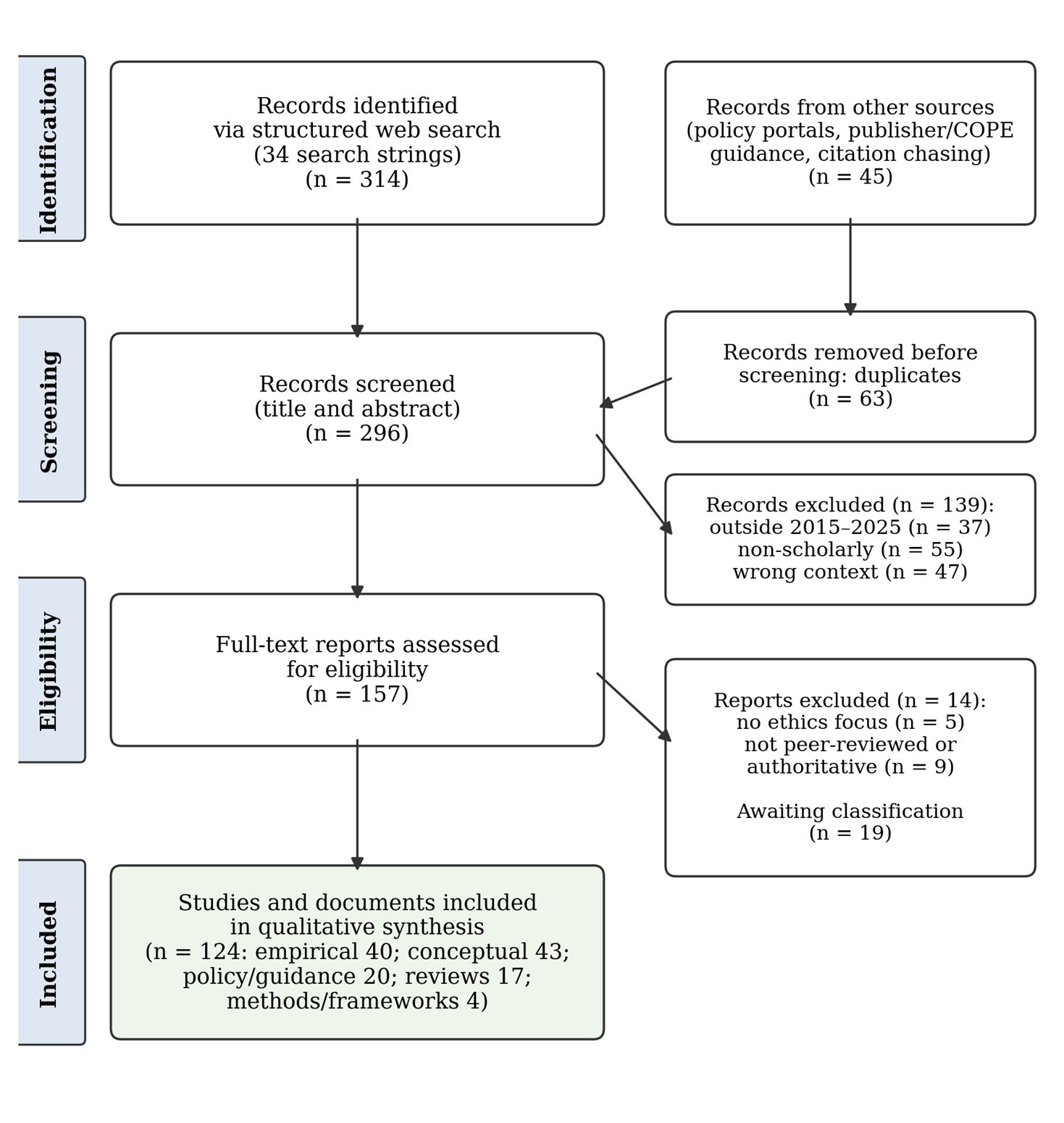
Results: Of 359 records identified, 124 met the eligibility criteria: 40 empirical studies, 43 conceptual analyses or commentaries, 20 policy and guidance documents, 17 reviews and 4 methodological frameworks; 83% were published from 2023 onwards. High-confidence findings were that guidance converges on no AI authorship, disclosure of substantive use and human accountability; that generative-AI use in research writing is widespread and largely undisclosed; that large language models fabricate references; and that AI-text detectors are unreliable and biased. Evidence and guidance were concentrated at the writing (76 items) and peer-review (39 items) stages, whereas the study-design and data stages were each supported by only four empirical studies.
Conclusions: Ethical attention and governance need to move upstream to the design and data stages of research. An evidence-weighted lifecycle framework is proposed that assigns governance gaps to researchers, institutions, publishers, funders and regulators, together with priorities for upstream empirical research, ethics-review reform, AI literacy in research training and international coordination.
Downloads
References
1. Jumper J, Evans R, Pritzel A, Green T, Figurnov M, et al. (2021) Highly accurate protein structure prediction with AlphaFold. Nature 596: 583-589.
2. Wang H, Fu T, Du Y, Gao W, Huang K, et al. (2023) Scientific discovery in the age of artificial intelligence. Nature 620: 47-60.
3. Van Noorden R, Perkel JM (2023) AI and science: What 1,600 researchers think. Nature 621: 672-675.
4. Liang W, Zhang Y, Wu Z, Lepp H, Ji W, et al. (2024) Mapping the increasing use of LLMs in scientific papers. arXiv:2404.01268.
5. National Commission for the Protection of Human Subjects of Biomedical and Behavioral Research (1979) The Belmont Report: Ethical principles and guidelines for the protection of human subjects of research. U.S. Department of Health, Education and Welfare.
6. Jobin A, Ienca M, Vayena E (2019) The global landscape of AI ethics guidelines. Nature Machine Intelligence 1: 389-399.
7. Mittelstadt B (2019) Principles alone cannot guarantee ethical AI. Nature Machine Intelligence 1: 501-507.
8. Morley J, Floridi L, Kinsey L, Elhalal A (2020) From what to how: An initial review of publicly available AI ethics tools, methods and research to translate principles into practices. Science and Engineering Ethics 26: 2141-2168.
9. Hagendorff T (2020) The ethics of AI ethics: An evaluation of guidelines. Minds and Machines 30: 99-120.
10. Kasneci E, Sessler K, Küchemann S, Bannert M, Dementieva D, et al. (2023) ChatGPT for good? On opportunities and challenges of large language models for education. Learning and Individual Differences 103: 102274.
11. Lund BD, Wang T, Mannuru NR, Nie B, Shimray S, et al. (2023) ChatGPT and a new academic reality: Artificial intelligence-written research papers and the ethics of the large language models in scholarly publishing. Journal of the Association for Information Science and Technology 74: 570-581.
12. Resnik DB, Hosseini M (2025) The ethics of using artificial intelligence in scientific research: New guidance needed for a new tool. AI and Ethics 5: 1499-1521.
13. Rana NK (2025) Generative AI and academic research: A review of the policies from selected HEIs. Higher Education for the Future 12(1): 97-113.
14. Munn Z, Peters MDJ, Stern C, Tufanaru C, McArthur A, et al. (2018) Systematic review or scoping review? Guidance for authors when choosing between a systematic or scoping review approach. BMC Medical Research Methodology 18: 143.
15. Peters MDJ, Marnie C, Tricco AC, Pollock D, Munn Z, et al. (2020) Updated methodological guidance for the conduct of scoping reviews. JBI Evidence Synthesis 18: 2119-2126.
16. Beauchamp TL, Childress JF (2019) Principles of biomedical ethics. 8th edn. Oxford University Press.
17. Organisation for Economic Co-operation and Development (OECD) (2019) Recommendation of the council on artificial intelligence (OECD/LEGAL/0449). OECD Publishing.
18. UNESCO (2021) Recommendation on the ethics of artificial intelligence. United Nations Educational, Scientific and Cultural Organization.
19. Floridi L, Cowls J (2019) A unified framework of five principles for AI in society. Harvard Data Science Review 1.
20. Barredo Arrieta A, Díaz-Rodríguez N, Del Ser J, Bennetot A, Tabik S, et al. (2020) Explainable artificial intelligence (XAI): Concepts, taxonomies, opportunities and challenges toward responsible AI. Information Fusion 58: 82-115.
21. Rudin C (2019) Stop explaining black box machine learning models for high stakes decisions and use interpretable models instead. Nature Machine Intelligence 1: 206-215.
22. Haibe-Kains B, Adam GA, Hosny A, Khodakarami F, Massive Analysis Quality Control (MAQC) Society Board of Directors, et al. (2020) Transparency and reproducibility in artificial intelligence. Nature 586: E14-E16.
23. Mehrabi N, Morstatter F, Saxena N, Lerman K, Galstyan A (2021) A survey on bias and fairness in machine learning. ACM Computing Surveys 54(6): 1-35.
24. Birhane A (2021) Algorithmic injustice: A relational ethics approach. Patterns 2: 100205.
25. Crawford K (2021) Atlas of AI: Power, politics and the planetary costs of artificial intelligence. Yale University Press.
26. Metcalf J, Crawford K (2016) Where are human subjects in Big Data research? The emerging ethics divide. Big Data & Society 3.
27. Rocher L, Hendrickx JM, de Montjoye YA (2019) Estimating the success of re-identifications in incomplete datasets using generative models. Nature Communications 10: 3069.
28. Committee on Publication Ethics (COPE) (2023) Authorship and AI tools: COPE position statement.
29. International Committee of Medical Journal Editors (ICMJE) (2024) Recommendations for the conduct, reporting, editing and publication of scholarly work in medical journals.
30. Raji ID, Smart A, White RN, Mitchell M, Gebru T, et al. (2020) Closing the AI accountability gap: Defining an end-to-end framework for internal algorithmic auditing. In Proceedings of the 2020 Conference on Fairness, Accountability and Transparency. ACM 33-44.
31. Strubell E, Ganesh A, McCallum A (2019) Energy and policy considerations for deep learning in NLP. In Proceedings of the 57th Annual Meeting of the Association for Computational Linguistics. ACL 3645-3650.
32. Bender EM, Gebru T, McMillan-Major A, Shmitchell S (2021) On the dangers of stochastic parrots: Can language models be too big? In Proceedings of the 2021 ACM Conference on Fairness, Accountability and Transparency. ACM 610-623.
33. Tricco AC, Lillie E, Zarin W, O'Brien KK, Colquhoun H, et al. (2018) PRISMA extension for scoping reviews (PRISMA-ScR): Checklist and explanation. Annals of Internal Medicine 169: 467-473.
34. Arksey H, O'Malley L (2005) Scoping studies: Towards a methodological framework. International Journal of Social Research Methodology 8: 19-32.
35. Levac D, Colquhoun H, O'Brien KK (2010) Scoping studies: Advancing the methodology. Implementation Science 5: 69.
36. Snilstveit B, Vojtkova M, Bhavsar A, Stevenson J, Gaarder M (2016) Evidence & gap maps: A tool for promoting evidence informed policy and strategic research agendas. Journal of Clinical Epidemiology 79: 120-129.
37. Page MJ, McKenzie JE, Bossuyt PM, Boutron I, Hoffmann TC, et al. (2021) The PRISMA 2020 statement: An updated guideline for reporting systematic reviews. BMJ 372: n71.
38. Gray A (2024) ChatGPT “contamination”: Estimating the prevalence of LLMs in the scholarly literature. arXiv:2403.16887.
39. Kobak D, González-Márquez R, Horvát EÁ, Lause J (2025) Delving into LLM-assisted writing in biomedical publications through excess vocabulary. Science Advances 11: eadt3813.
40. Walters WH, Wilder EI (2023) Fabrication and errors in the bibliographic citations generated by ChatGPT. Scientific Reports 13: 14045.
41. Weber-Wulff D, Anohina-Naumeca A, Bjelobaba S, Foltýnek T, Guerrero-Dib J, et al. (2023) Testing of detection tools for AI-generated text. International Journal for Educational Integrity 19: 26.
42. Hartung J, Reuter S, Kulow VA, Fähling M, Spreckelsen C, et al. (2024) Experts fail to reliably detect AI-generated histological data. Scientific Reports 14.
43. Ganjavi C, Eppler MB, Pekcan A, Biedermann B, Abreu A, et al. (2024) Publishers’ and journals’ instructions to authors on use of generative artificial intelligence in academic and scientific publishing: Bibliometric analysis. BMJ 384: e077192.
44. Lund BD, Naheem KT (2024) Can ChatGPT be an author? A study of artificial intelligence authorship policies in top academic journals. Learned Publishing 37: 13-21.
45. Stokel-Walker C (2023) ChatGPT listed as author on research papers: Many scientists disapprove. Nature 613: 620-621.
46. Thorp HH (2023) ChatGPT is fun, but not an author. Science 379: 313.
47. Zielinski C, Winker MA, Aggarwal R, Ferris LE, Heinemann M, et al. (2023) Chatbots, generative AI and scholarly manuscripts: WAME recommendations on chatbots and generative artificial intelligence in relation to scholarly publications. World Association of Medical Editors.
48. Flanagin A, Kendall-Taylor J, Bibbins-Domingo K (2023) Guidance for authors, peer reviewers and editors on use of AI, language models and chatbots. JAMA 330: 702-703.
49. Kaebnick GE, Magnus DC, Kao A, Hosseini M, Resnik D, et al. (2023) Editors’ statement on the responsible use of generative AI technologies in scholarly journal publishing. Hastings Center Report 53: 3-6.
50. Hosseini M, Resnik DB, Holmes K (2023) The ethics of disclosing the use of artificial intelligence tools in writing scholarly manuscripts. Research Ethics 19: 449-465.
51. Nature (2023) Tools such as ChatGPT threaten transparent science; here are our ground rules for their use. Nature 613: 612.
52. Elsevier (2023) The use of generative AI and AI-assisted technologies in writing for Elsevier.
53. National Institute of Standards and Technology (NIST) (2023) Artificial intelligence risk management framework (AI RMF 1.0) (NIST AI 100-1).
54. Hosseini M, Horbach SPJM (2023) Fighting reviewer fatigue or amplifying bias? Considerations and recommendations for use of ChatGPT and other large language models in scholarly peer review. Research Integrity and Peer Review 8: 4.
55. Liang W, Izzo Z, Zhang Y, Lepp H, Cao H, et al. (2024) Monitoring AI-modified content at scale: A case study on the impact of ChatGPT on AI conference peer reviews. In Proceedings of the 41st International Conference on Machine Learning (PMLR 235).
56. Latona GR, Ribeiro MH, Davidson TR, Veselovsky V, West R (2025) The AI review lottery: Widespread AI-assisted peer reviews boost paper scores and acceptance rates. Proceedings of the ACM on Human-Computer Interaction.
57. Mollaki V (2024) Death of a reviewer or death of peer review integrity? The challenges of using AI tools in peer reviewing and the need to go beyond publishing policies. Research Ethics 20: 239-250.
58. Elkhatat AM, Elsaid K, Almeer S (2023) Evaluating the efficacy of AI content detection tools in differentiating between human and AI-generated text. International Journal for Educational Integrity 19: 17.
59. Liang W, Yuksekgonul M, Mao Y, Wu E, Zou J (2023) GPT detectors are biased against non-native English writers. Patterns 4: 100779.
60. European Union (2024) Regulation (EU) 2024/1689 of the European Parliament and of the Council of 13 June 2024 laying down harmonised rules on artificial intelligence (Artificial Intelligence Act). Official Journal of the European Union, L series.
61. Resnik DB, Hosseini M (2025) Disclosing artificial intelligence use in scientific research and publication: When should disclosure be mandatory, optional, or unnecessary? Accountability in Research 33.
62. Hosseini M, Gordijn B, Kaebnick GE, Holmes K (2025) Disclosing generative AI use for writing assistance should be voluntary. Research Ethics 21(4): 728-735.
63. Elsevier (2024) Insights 2024: Attitudes toward AI. Elsevier.
64. Friesen P, Douglas-Jones R, Marks M, Pierce R, Fletcher K, et al. (2021) Governing AI-driven health research: Are IRBs up to the task? Ethics & Human Research 43: 35-42.
65. Ferretti A, Ienca M, Sheehan M, Blasimme A, Dove ES, et al. (2021) Ethics review of big data research: What should stay and what should be reformed? BMC Medical Ethics 22: 51.
66. Bouhouita-Guermech S, Gogognon P, Bélisle-Pipon JC (2023) Specific challenges posed by artificial intelligence in research ethics. Frontiers in Artificial Intelligence 6: 1149082.
67. Secretary’s Advisory Committee on Human Research Protections (SACHRP) (2022) Considerations for IRB review of research involving artificial intelligence. U.S. Department of Health and Human Services.
68. Nanayakkara P, Hullman J, Diakopoulos N (2021) Unpacking the expressed consequences of AI research in broader impact statements. In Proceedings of the 2021 AAAI/ACM Conference on AI, Ethics and Society. ACM 795 - 806.
69. Ashurst C, Hine E, Sedille P, Carlier A (2022) AI ethics statements: Analysis and lessons learnt from NeurIPS broader impact statements. In Proceedings of the 2022 ACM Conference on Fairness, Accountability and Transparency. ACM 2047-2056.
70. Liu D, Nanayakkara P, Sakha SA, Abuhamad G, Blodgett SL, et al. (2022) Examining responsibility and deliberation in AI impact statements and ethics reviews. In Proceedings of the 2022 AAAI/ACM Conference on AI, Ethics and Society. ACM 424-435.
71. Birhane A, Kalluri P, Card D, Agnew W, Dotan R, et al. (2022) The values encoded in machine learning research. In Proceedings of the 2022 ACM Conference on Fairness, Accountability and Transparency. ACM 173-184.
72. Dillion D, Tandon N, Gu Y, Gray K (2023) Can AI language models replace human participants? Trends in Cognitive Sciences 27: 597-600.
73. Grossmann I, Feinberg M, Parker DC, Christakis NA, Tetlock PE, et al. (2023) AI and the transformation of social science research. Science 380: 1108-1109.
74. Bail CA (2024) Can generative AI improve social science? Proceedings of the National Academy of Sciences 121: e2314021121.
75. Buolamwini J, Gebru T (2018) Gender shades: Intersectional accuracy disparities in commercial gender classification. Proceedings of Machine Learning Research 81: 77-91.
76. Obermeyer Z, Powers B, Vogeli C, Mullainathan S (2019) Dissecting racial bias in an algorithm used to manage the health of populations. Science 366: 447-453.
77. Selbst AD, Boyd D, Friedler SA, Venkatasubramanian S, Vertesi J (2019) Fairness and abstraction in sociotechnical systems. In Proceedings of the Conference on Fairness, Accountability and Transparency. ACM, pp. 59–68.
78. Zook M, Barocas S, Boyd D, Crawford K, Keller E, et al. (2017) Ten simple rules for responsible big data research. PLOS Computational Biology 13: e1005399.
79. Wilkinson MD, Dumontier M, Aalbersberg IJ, Appleton G, Axton M, et al. (2016) The FAIR Guiding Principles for scientific data management and stewardship. Scientific Data 3: 160018.
80. Alkaissi H, McFarlane SI (2023) Artificial hallucinations in ChatGPT: Implications in scientific writing. Cureus 15: e35179.
81. Bhattacharyya M, Miller VM, Bhattacharyya D, Miller LE (2023) High rates of fabricated and inaccurate references in ChatGPT-generated medical content. Cureus 15: e39238.
82. Chelli M, Descamps J, Lavoué V, Trojani C, Azar M, et al. (2024) Hallucination rates and reference accuracy of ChatGPT and Bard for systematic reviews: Comparative analysis. Journal of Medical Internet Research 26: e53164.
83. Kendall G, Teixeira da Silva JA (2024) Risks of abuse of large language models, like ChatGPT, in scientific publishing: Authorship, predatory publishing and paper mills. Learned Publishing 37: 55-62.
84. Gu J, Wang X, Li C, Zhao J, Fu W, et al. (2022) AI-enabled image fraud in scientific publications. Patterns 3: 100511.
85. Binz M, Alaniz S, Roskies A, Aczel B, Bergstrom CT, et al. (2025) How should the advancement of large language models affect the practice of science? Proceedings of the National Academy of Sciences 122: e2401227121.
86. Gundersen OE, Kjensmo S (2018) State of the art: Reproducibility in artificial intelligence. Proceedings of the AAAI Conference on Artificial Intelligence 32: 1644-1651.
87. Kapoor S, Narayanan A (2023) Leakage and the reproducibility crisis in machine-learning-based science. Patterns 4: 100804.
88. Gao CA, Howard FM, Markov NS, Dyer EC, Ramesh S, et al. (2023) Comparing scientific abstracts generated by ChatGPT to real abstracts with detectors and blinded human reviewers. npj Digital Medicine 6: 75.
89. Messeri L, Crockett MJ (2024) Artificial intelligence and illusions of understanding in scientific research. Nature 627: 49-58.
90. Shumailov I, Shumaylov Z, Zhao Y, Papernot N anderson R, et al. (2024) AI models collapse when trained on recursively generated data. Nature 631: 755–759.
91. Eacersall D, Pretorius L, Smirnov I, Spray E, Illingworth S, et al. (2024) Navigating ethical challenges in generative AI-enhanced research: The ETHICAL framework for responsible generative AI use. arXiv:2501.09021.
92. European Commission (2024) Living guidelines on the responsible use of generative AI in research. Directorate-General for Research and Innovation, ERA Forum.
93. Munn L (2023) The uselessness of AI ethics. AI and Ethics 3: 869-877.
94. Whittlestone J, Nyrup R, Alexandrova A, Cave S (2019) The role and limits of principles in AI ethics: Towards a focus on tensions. In Proceedings of the 2019 AAAI/ACM Conference on AI, Ethics and Society. ACM 195-200.
95. Bockting CL, van Dis EAM, van Rooij R, Zuidema W, Bollen J (2023) Living guidelines for generative AI — why scientists must oversee its use. Nature 622: 693-696.
96. Gebru T, Morgenstern J, Vecchione B, Vaughan JW, Wallach H, et al. (2021) Datasheets for datasets. Communications of the ACM 64: 86-92.
97. Mitchell M, Wu S, Zaldivar A, Barnes P, Vasserman L, et al. (2019) Model cards for model reporting. In Proceedings of the Conference on Fairness, Accountability and Transparency. ACM 220-229.
98. Pushkarna M, Zaldivar A, Kjartansson O (2022) Data cards: Purposeful and transparent dataset documentation for responsible AI. In Proceedings of the 2022 ACM Conference on Fairness, Accountability and Transparency. ACM 1776-1826.
99. Liang W, Rajani N, Yang X, Ozoani E, Wu E, et al. (2024) What’s documented in AI? Systematic analysis of 32K AI model cards. arXiv:2402.05160.
100. Liu X, Cruz Rivera S, Moher D, Calvert MJ, Denniston AK, et al. (2020) Reporting guidelines for clinical trial reports for interventions involving artificial intelligence: The CONSORT-AI extension. Nature Medicine 26: 1364-1374.
101. Cruz Rivera S, Liu X, Chan AW, Denniston AK, Calvert MJ, et al. (2020) Guidelines for clinical trial protocols for interventions involving artificial intelligence: The SPIRIT-AI extension. Nature Medicine 26: 1351-1363.
102. Collins GS, Moons KGM, Dhiman P, Riley RD, Beam AL, et al. (2024) TRIPOD+AI statement: Updated guidance for reporting clinical prediction models that use regression or machine learning methods. BMJ 385: e078378.
103. Nosek BA, Alter G, Banks GC, Borsboom D, Bowman SD, et al. (2015) Promoting an open research culture. Science 348: 1422-1425.
104. Dwivedi YK, Kshetri N, Hughes L, Slade EL, Jeyaraj A, et al. (2023) “So what if ChatGPT wrote it?” Multidisciplinary perspectives on opportunities, challenges and implications of generative conversational AI for research, practice and policy. International Journal of Information Management 71: 102642.
105. van Dis EAM, Bollen J, Zuidema W, van Rooij R, Bockting CL (2023) ChatGPT: Five priorities for research. Nature 614: 224-226.
106. Stilgoe J, Owen R, Macnaghten P (2013) Developing a framework for responsible innovation. Research Policy 42: 1568-1580.